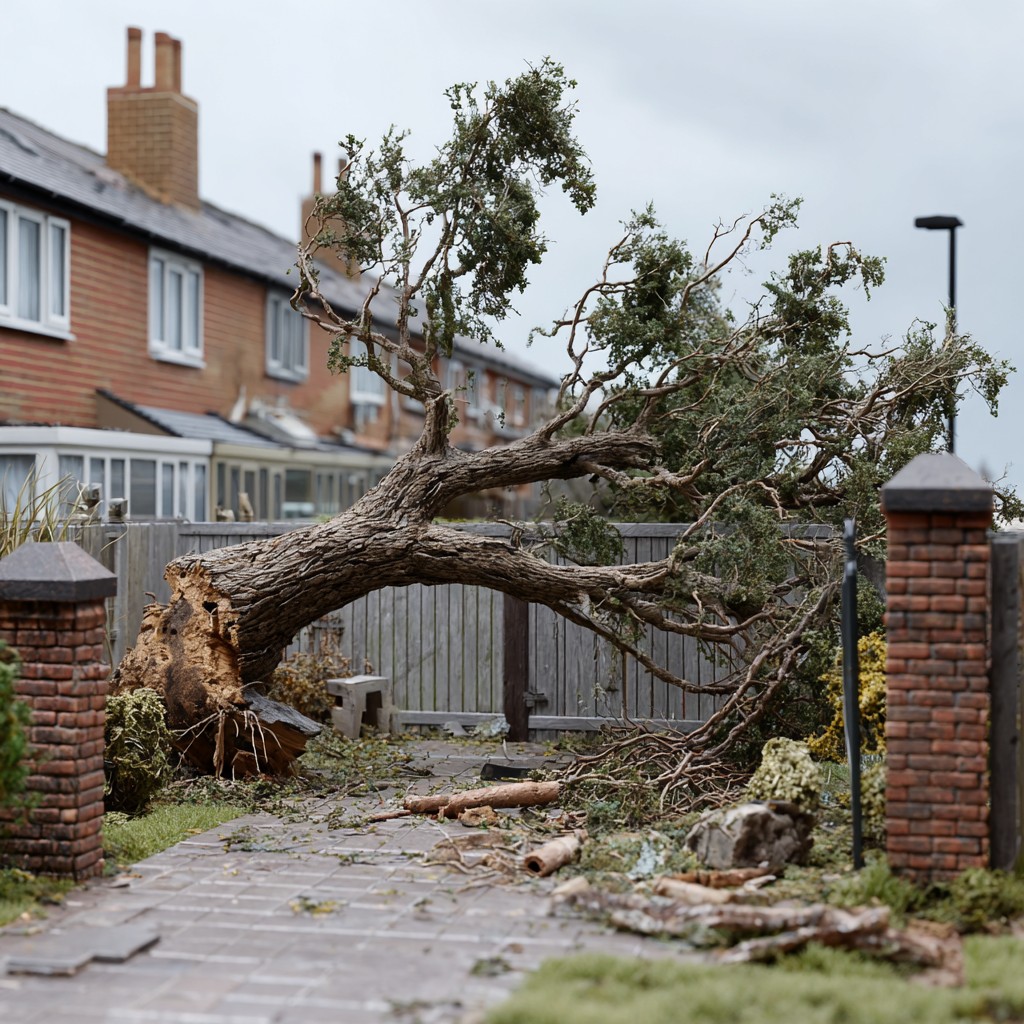
A storm rolls through London overnight, and by morning a tree – yours, your neighbour’s, or one whose ownership you have never had cause to think about – has come down across the boundary fence. The physical damage is obvious and immediate. What is considerably less obvious, and considerably more contested in the conversations that follow, is the question of who is responsible for what. Liability, insurance, tree ownership, boundary ownership and the obligations that attach to each are four distinct matters that London homeowners and garden managers routinely conflate, with consequences that range from unnecessary expense to protracted neighbour disputes that damage relationships for years. This article sets out what actually applies, in what order, and what practical steps produce the best outcomes for everyone involved.
Immediate Priorities: Safety Before Liability
The question of who pays comes second. The first priority, in every case, is safety – and this is not a platitude. A storm-damaged tree lying across a fence may look static, but the situation is frequently more dynamic than it appears. Secondary branches under tension can release without warning. Root plates that have partially lifted can drop back or shift further as saturated ground settles. Where the fallen tree or its branches are in contact with overhead power lines, the scene should be treated as a live electrical hazard until the network operator – UK Power Networks in most of London – has confirmed otherwise.
If the tree is blocking vehicular access, has damaged a structure that makes it unsafe to occupy, or presents an immediate hazard to people, emergency contact with a qualified arboricultural contractor is appropriate regardless of who owns the tree or who will ultimately bear the cost. Most professional tree surgeons in London maintain an emergency call-out service precisely for storm events, and most household insurance policies with emergency home cover extend to the cost of making safe rather than full clearance and reinstatement. Establishing that distinction early – making safe versus full remediation – is useful both practically and in terms of managing the insurance process.
Once the immediate hazard is resolved and the situation is stable, the questions of ownership, liability and cost can be addressed without urgency dictating poor decisions.
Establishing Who Owns the Tree and Who Owns the Fence
Tree Ownership
In English law, a tree belongs to the owner of the land on which it grows – specifically, the land from which it grows, not the land over which its canopy extends or across which its roots travel. Establishing tree ownership therefore requires establishing where the base of the tree sits in relation to the boundary line. For trees growing close to boundaries, this can be a genuinely ambiguous question, and title deeds, Land Registry plans and any boundary agreement documents should be consulted before any assumption is made.
Where a tree straddles a boundary – meaning its trunk grows from both sides of the legal boundary line – it is technically in shared ownership, with each party owning the portion that grows from their land. This is relatively uncommon but not unknown in older London gardens where boundary positions have shifted or were imprecisely recorded. Where genuine uncertainty exists, a boundary surveyor’s assessment may be necessary before liability discussions can proceed on a sound footing.
Fence and Boundary Ownership
Boundary ownership in England and Wales is determined by the title deeds and any attached boundary agreements, not by convention or assumption. The widespread belief that you own the fence on the left side of your garden looking from the front is a myth with no basis in law – it is simply a common conveyancing convention that many developers have historically used, and which does not apply universally. The Land Registry’s title plan will show the legal boundary line, and the deeds may include a boundary ownership notation, often indicated by a T-mark on the plan sitting on the side of the boundary belonging to the owner of that feature.
Where deeds are silent or ambiguous on boundary ownership – which is more common than most homeowners expect – ownership may be unclear, and reaching a practical agreement with the neighbouring party is frequently more productive than pursuing a legal determination, which can be both slow and disproportionately expensive relative to the value of a garden fence.
The Question of Liability: What the Law Actually Says
This is the area where misunderstanding is most common and most costly, and the legal position is more nuanced than either party in a post-storm dispute typically assumes.
When the Fallen Tree Is Yours
If your tree has fallen and damaged your neighbour’s fence, your liability depends not on the fact of the tree falling but on whether you were negligent in failing to prevent it. English law does not impose strict liability on tree owners for damage caused by falling trees – the standard is one of reasonable knowledge and reasonable action. If your tree was visibly diseased, structurally compromised, or the subject of a previous complaint or professional report that identified a risk, and you failed to act on that knowledge, liability is likely to attach to you. If the tree appeared healthy and well-maintained, and the storm was of an exceptional severity, the legal position is considerably less clear, and your neighbour may find that their own insurance is the appropriate first recourse.
This principle – sometimes described as the “reasonable foreseeability” test – is why professional tree inspections matter as both an ecological and a risk-management tool. A homeowner who has had their trees periodically assessed by a qualified arborist, and who has acted on any recommendations made, is in a significantly stronger legal position than one who has not.
When Your Neighbour’s Tree Falls on Your Property
The same principle applies in reverse. Your neighbour is not automatically liable for damage their tree has caused to your fence, your garden structures or your property simply by virtue of owning the tree. If the tree was healthy and the fall was caused by storm conditions beyond the ordinary, you may find that pursuing your neighbour for the cost of reinstatement is neither legally straightforward nor neighbourly in its long-term effects. In most such cases, your own buildings or home insurance policy – particularly if it includes garden structures – is the appropriate first port of call, with the excess and any claim impact on your premium weighed against the cost of self-funding the repair.
Where there is a credible case that the neighbour knew or should have known about a structural defect in the tree, photographic evidence of the tree’s pre-fall condition, any correspondence about the tree’s health, and any professional reports are all relevant to establishing that case.
Insurance: The Practical First Step for Most Homeowners
Regardless of the liability position, contacting your own insurer at an early stage is almost always the most practical course of action. Home insurance policies vary considerably in what they cover in relation to garden damage, trees and boundary structures, and establishing what your own policy provides should happen before significant expenditure is committed.
Key questions to establish with your insurer include whether the policy covers boundary fence damage from fallen trees regardless of ownership, whether it covers the cost of removing the fallen tree from the property, whether garden structures and hard landscaping damaged by the fall are included, and what the applicable excess is. Some policies specifically exclude tree removal unless the fallen tree has damaged an insured structure – a fence alone may not meet that threshold under all policies, which is a detail worth establishing before assuming full cover applies.
Where the neighbouring party’s negligence is demonstrable and your insurer accepts the claim, subrogation – the process by which your insurer pursues the responsible party for recovery of their costs – means that you are not required to conduct that pursuit yourself. This is frequently the most straightforward route when a clear liability case exists, as it removes the homeowner from the direct negotiation and places it between the two insurers.
Managing the Neighbour Relationship: Approach and Communication
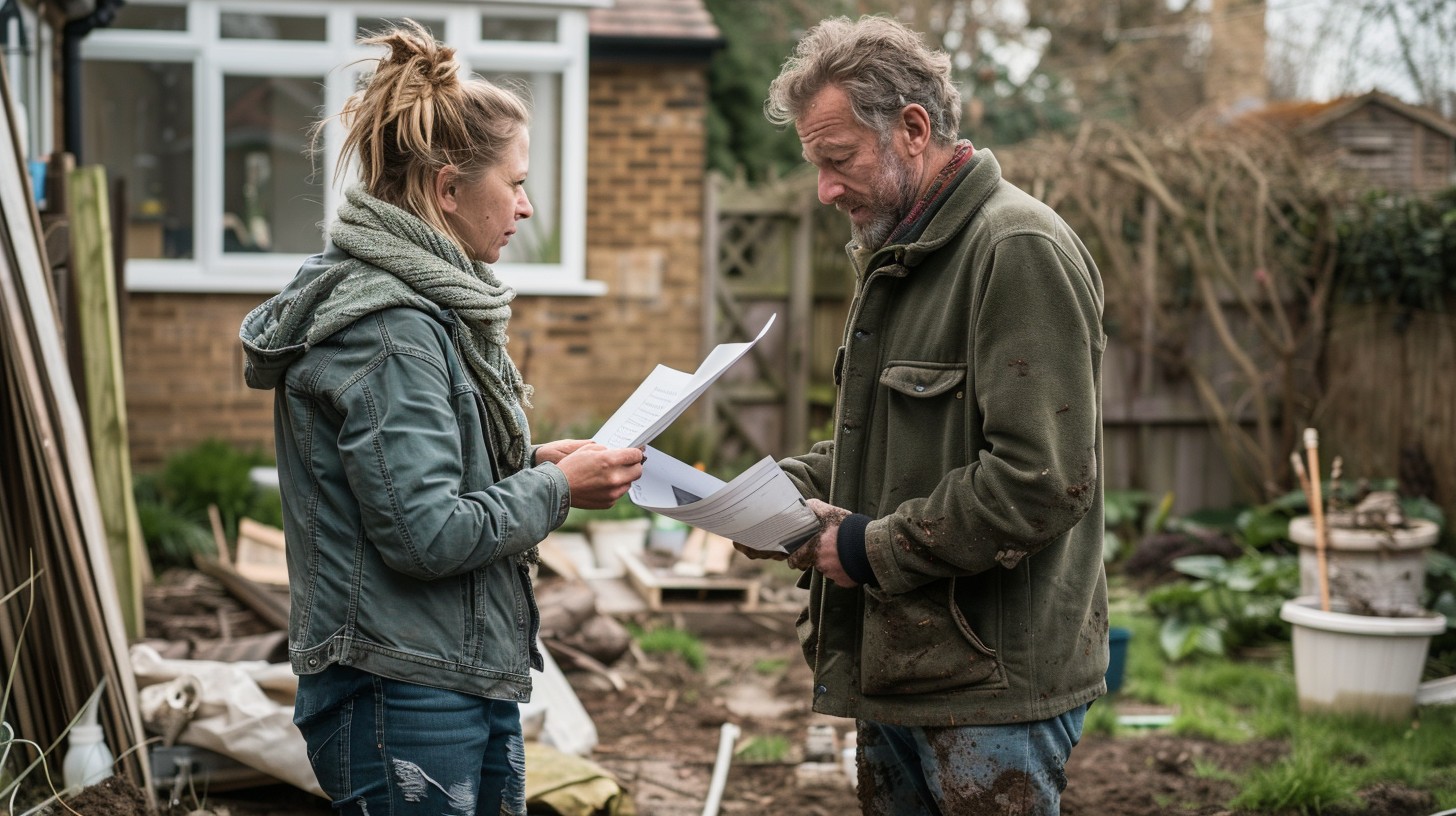
Storm damage to boundary features is one of the most common triggers for neighbour disputes in London residential properties, and the manner in which the initial conversation is handled shapes the relationship for years afterwards. The legal position, however well-founded, is rarely the most important factor in determining whether a dispute escalates or resolves.
Early, calm and factual communication – acknowledging that both parties have been affected by an event that neither caused, expressing a shared interest in resolving the situation practically, and avoiding any immediate attribution of blame before the facts are established – sets a productive tone. Where both parties are genuinely uncertain about liability, acknowledging that uncertainty openly is more constructive than each side asserting a confident position that subsequent legal advice may not support.
Written communication, kept factual and courteous throughout, provides a record that is useful if the matter does progress to a formal dispute. Mediation services – available through several London-based providers and increasingly recommended by the courts as a first step before litigation in neighbour disputes – offer a structured route to resolution that is significantly cheaper, faster and less damaging to ongoing relationships than legal proceedings.
The Tree After the Storm: Assessment, Reinstatement and Prevention
Once the immediate situation is resolved, the question of what happens to the remaining tree or trees on the affected boundary is worth addressing directly rather than deferring. A tree that has partially failed in a storm – whether the main stem has broken, a major limb has detached, or the root plate has partially lifted – should be assessed by a qualified arborist before any decision is made about its future. Partial failure does not automatically mean full removal is required; in many cases, skilled remedial pruning and a period of monitored recovery can preserve a tree that would otherwise be lost.
Where removal is confirmed as necessary, the implications for the boundary, the soil and the neighbouring structures – particularly on London clay, where tree removal carries the heave risks discussed elsewhere in this series – should inform both the method of removal and any replanting decisions that follow.
After the Storm Clears: Knowing Where You Stand
Storm damage reveals, with considerable efficiency, exactly which aspects of a property’s legal and maintenance position have been left unexamined. Boundary ownership that was never formally established, trees that had not been professionally assessed, insurance policies whose scope had never been tested against a real event, and neighbour relationships whose goodwill had been assumed rather than cultivated – all of these are brought sharply into focus by a single overnight storm.
The homeowners who navigate these events most effectively are those who entered them with the clearest picture of where their boundaries lie, what condition their trees are in, and what their insurance actually provides. None of that knowledge is difficult to acquire in advance. It simply requires asking the questions before the tree comes down, rather than after.