If you have submitted a planning application in London in recent years and found sustainable drainage appearing as a condition – or as a reason for objection – you are not alone. SuDS-compliant landscaping has moved decisively from aspirational best practice to a baseline planning expectation across most London boroughs, driven by a convergence of national policy reform, the London Plan, and the increasingly visible consequences of surface water flooding across the capital. For garden owners, developers and landscape contractors alike, understanding why this shift has happened – and what it means in practical design terms – is no longer optional. It is a fundamental part of navigating the London planning system with confidence.
What SuDS Means – and Why Landscaping Is Central to It
Sustainable Drainage Systems – SuDS – is the collective term for a range of techniques designed to manage surface water runoff as close to its source as possible, mimicking the natural water cycle rather than routing rainwater directly into the sewer network. The principle is straightforward: slow the water down, spread it out, and allow it to infiltrate, evaporate or be stored and released gradually, rather than generating the rapid peak flows that overwhelm combined sewers and cause flooding downstream.
What distinguishes SuDS from conventional drainage engineering is that landscape is its primary medium. Permeable paving, rain gardens, swales, green roofs, detention basins, tree pits and planted attenuation features are not decorative additions to a SuDS scheme – they are the scheme. This is why landscape contractors and garden designers are now central figures in the SuDS conversation rather than peripheral ones, and why the technical rigour of landscape proposals has become a meaningful factor in planning outcomes across London.
The SuDS management train – a hierarchy moving from prevention and source control through to site and regional management – prioritises the smallest, most distributed interventions first. Good landscape design is, by definition, the first line of response.
The Policy Framework Driving the Change
National Planning Policy and the Flood and Water Management Act
The policy foundations for SuDS in England rest on two principal instruments. The National Planning Policy Framework – updated most recently in December 2023 – requires that sustainable drainage systems be given priority consideration in all new developments, with surface water managed in accordance with the SuDS hierarchy. The updated NPPF makes clear that major developments should incorporate SuDS unless there is a demonstrable reason why it is inappropriate, and that drainage proposals should be designed to manage water for the full lifetime of the development.
Underpinning this is Schedule 3 of the Flood and Water Management Act 2010, which establishes a statutory framework for SuDS approval. Under Schedule 3, Lead Local Flood Authorities – the borough councils, in the London context – hold an approval role for drainage in new developments that sits alongside, and is linked to, the planning process. The practical effect is that drainage proposals must satisfy the approving body’s technical standards before planning consent can be considered complete. SuDS is no longer simply a material planning consideration to be weighed and balanced; it carries a statutory approval mechanism with it.
The London Plan and Borough-Level Requirements
The London Plan 2021 strengthens these national requirements considerably. Policy SI 12 requires that development should aim to achieve greenfield runoff rates and use SuDS unless there are practical reasons for not doing so, setting out a clear preference for multifunctional blue-green infrastructure that delivers drainage, biodiversity, amenity and urban cooling benefits simultaneously. Policy SI 13 addresses the need to reduce flood risk from all sources, with surface water management plans a key tool for borough-level implementation.
The Mayor’s Urban Greening Factor – introduced through Policy G5 – adds a further layer, requiring that development proposals in London achieve minimum greening scores that can only be met through combinations of green roofs, green walls, trees, soft landscaping and permeable surfaces. Many of the most effective ways to score against the Urban Greening Factor are also SuDS measures. The two policies are, in design terms, deeply complementary – and satisfying one well tends to advance the other.
What SuDS-Compliant Landscaping Looks Like in Practice
Permeable Surfaces and Rain Gardens
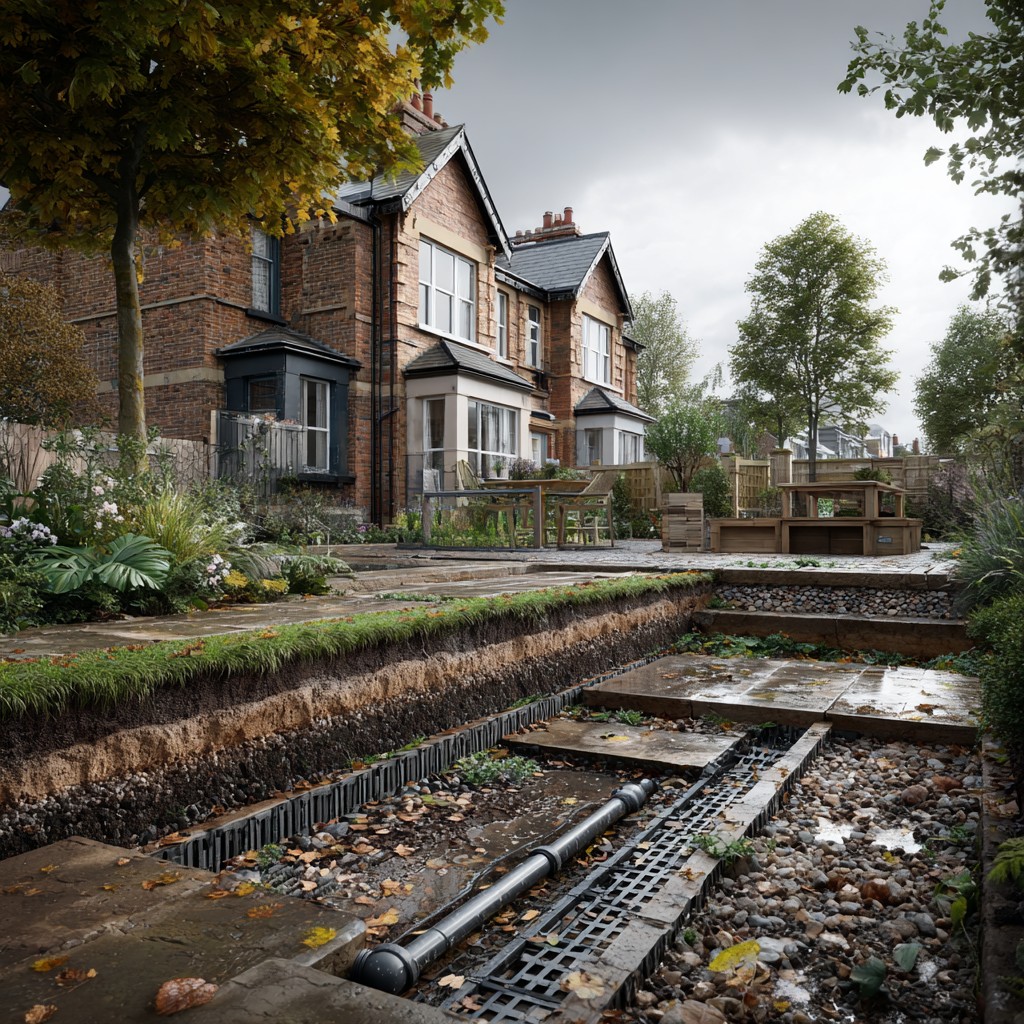
At the residential and smaller commercial scale, the most common SuDS interventions are surface-based. Permeable paving – whether block paving with open joints, resin-bound gravel, or reinforced grass – allows water to pass through the surface and into a sub-base that attenuates flow before slow infiltration into the ground below. Front garden paving has been a particular focus of policy attention in London, as the widespread loss of permeable front garden surfaces to hardstanding has contributed significantly to localised surface water flooding across inner boroughs.
Rain gardens occupy the next tier of the management train: planted depressions or shallow basins, typically positioned to receive runoff from roofs, driveways or paths, that hold water temporarily and allow it to infiltrate while providing habitat and planting interest. Well-designed rain gardens are visually indistinguishable from conventional planting schemes, and they represent one of the most elegant fusions of ecological and drainage function available in the landscape designer’s toolkit.
Swales, Green Roofs and Attenuation Features
At larger scales – whether a substantial residential garden, a commercial courtyard or a housing development’s shared landscape – the SuDS palette broadens considerably. Swales are shallow, vegetated channels that convey water slowly across a site while allowing infiltration and filtering of pollutants. Green roofs, from simple sedum mats to complex biodiverse substrates, intercept rainfall at source and reduce both the volume and rate of runoff reaching ground level. Below-ground or surface attenuation features – oversized planting pits, permeable tree trenches, or linked detention basins – can manage significant volumes of water while simultaneously supporting mature tree establishment and long-term canopy cover.
The key design principle in all cases is integration: SuDS features should be components of the landscape composition, not engineering additions grafted onto an otherwise conventional scheme.
SuDS in Smaller Residential Projects – What Homeowners Need to Know
A persistent misconception is that SuDS requirements apply only to major developments – large housing schemes, commercial buildings or strategic infrastructure. In London, this is no longer an accurate picture. Permitted development rules for front garden hardstanding have required permeable surfaces or adequate drainage provision since 2008, and the planning policies described above apply to householder applications as well as major schemes, albeit with proportionate expectations.
For homeowners seeking planning permission for extensions with associated landscaping changes, basement conversions affecting drainage, or significant regrading of garden levels, demonstrating a considered approach to surface water management has become a routine expectation. Applications that ignore drainage implications entirely are increasingly likely to draw comment from the Lead Local Flood Authority as a statutory consultee, delaying determination and sometimes requiring redesign before a decision can be issued.
Integrating SuDS From the Design Stage, Not the Drainage Stage
The single most costly mistake in SuDS delivery is treating drainage as a separate technical exercise to be resolved after the landscape design is complete. When SuDS features are retrofitted onto a finished scheme, the results are typically expensive, spatially inefficient and aesthetically compromised. When they are embedded from the first design conversation – informing levels, surface selections, planting positions and boundary conditions from the outset – they become invisible in the best possible sense: fully absorbed into a landscape that performs beautifully while meeting its technical obligations without friction.
This is why the most effective landscape contractors working in London now bring drainage literacy to early client conversations, coordinate with structural and civil engineers before the scheme design is fixed, and develop proposals in which the distinction between landscape feature and drainage feature is deliberately blurred. A rain garden is a planting scheme. A swale is a lawn with considered topography. A permeable terrace is simply a well-specified terrace. None of these things need announce themselves as infrastructure to fulfil their function entirely.
Beyond the Application: The Longer Case for SuDS-Led Landscape Design
Planning compliance is the threshold argument for SuDS, but it is not the most compelling one. A landscape designed around sustainable drainage principles performs better over its lifetime in ways that have nothing to do with planning policy.
Reduced surface water runoff means less erosion, less waterlogging of planted areas and less pressure on the ageing combined sewers that serve most of inner London – a tangible benefit to the wider neighbourhood, not just the individual site. SuDS planting schemes, particularly rain gardens and biodiverse green roofs, tend to be ecologically richer and more resilient than conventional planting, supporting pollinators, birds and soil invertebrates while requiring less supplementary irrigation because they are positioned to capture and use rainfall efficiently.
Urban cooling is a further dividend. Vegetated surfaces and open water features moderate the heat island effect that makes London gardens uncomfortable during hot, dry summers, improving the usability of outdoor spaces in precisely the conditions when they matter most to the people who own and occupy them.
SuDS-compliant landscaping, in other words, is not a compliance burden to be managed and minimised. It is a design discipline – one that consistently produces landscapes that are more functional, more resilient and more ecologically generous than those conceived without water in mind.